Computational Cove, the SoCal Research Computing & Data Symposium
0.1 SoCal RCA is hosting the second Computational Cove symposium at the University of Southern California on October 2, 2026.
Date: Friday, October 2, 2026
Time: 10:00 AM - 3:00 PM
Location: University of Southern California
Caruso Catholic Center - Newman Hall
844 W 32nd St
Los Angeles, CA 90007
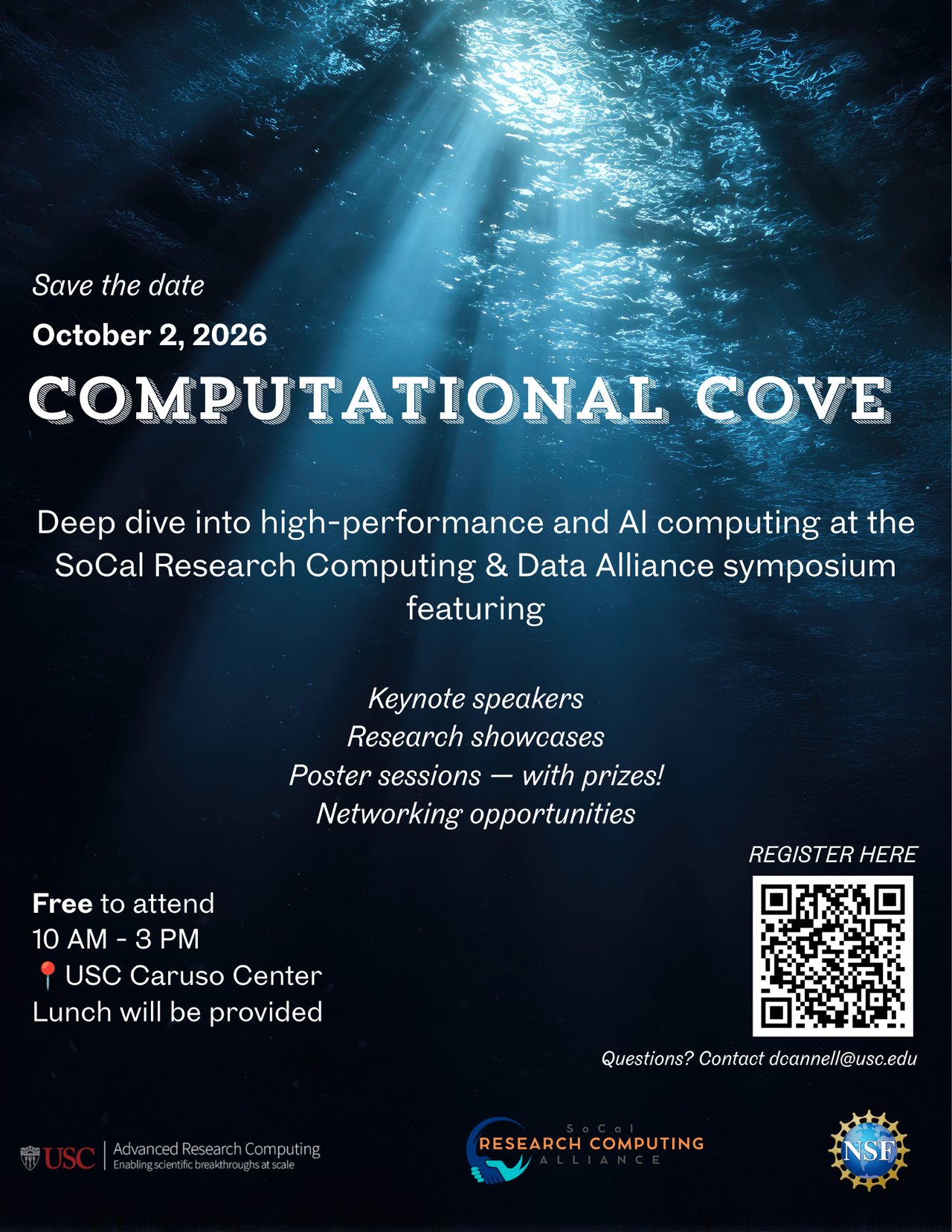
Join us for Computational Cove, a premier gathering designed to bring together SoCal Research Computing Alliance partners, researchers, students, and industry professionals in the fields of research computing, data science, AI computing, and innovation.
1 Highlights
This year’s symposium brings back opportunities for the SoCal advanced research computing community to explore, connect, and learn.
The symposium will feature a diverse program including:
- Keynote speeches: Hear from leading voices in computational research as they share insights on the current academic research computing landscape.
- Faculty research showcases: Faculty from across disciplines and institutions will present innovative research projects that demonstrate the power of advanced computing to drive discovery and innovation.
- Student research poster presentations: Students will have the chance to showcase their work in computational science, machine learning, and more.
2 Who Should Attend
This event is ideal for anyone involved or interested in computationally driven research and infrastructure, including:
- Researchers and Academics
- Data Scientists and Analysts
- Research Computing and IT Professionals
- Students in Computational Science, Data Science, and Computing
3 Schedule
Schedule is not finalized and subject to change.
| Time | Event | Speaker |
|---|---|---|
| 9:30 AM | Check-In | - |
| 10:00 AM | Opening Remarks | Byoung-Do (BD) Kim, Associate Chief Research Information Officer & Director of the Center for Advanced Research Computing |
| 10:10 AM | Keynote Speaker | Ahmed Elbanna, Director of USC SCEC: Computing for Resilience: From Earthquake Physics to Societal Impact |
| 11:00 AM | Research showcase | Karan Vahi, Senior Computer Scientist at USC ISI: AI Workflows on Laguna |
| 11:30 AM | Faculty research showcase | Rui Cheng, CMC Assistant Professor of Integrated Sciences: Fusing Cross-Scaled Sensing and Modeling of Land-Atmosphere Carbon Fluxes for Real-World Impact |
| 12:00 PM | Lunch | - |
| 1:00 PM | Poster Session | - |
| 2:00 PM | Poster Awards | - |
| 2:40 PM | Raffle Winners Announced | - |
| 2:50 PM | Closing Remarks | Jeho Park, Director of the Murty Sunak Quantitative and Computing Lab & Director of the Data Science Capstone Program |
4 Speakers and presentation abstracts
4.1 Ahmed Elbanna
Ahmed Elbanna is a Professor of Earth Sciences and Civil Engineering at the University of Southern California and Director of the Statewide California Earthquake Center (SCEC). His research focuses on the physics and mechanics of earthquakes and other geohazards, with particular emphasis on earthquake rupture dynamics, fault-zone processes, seismic hazards, and the interactions between natural hazards and the built environment. His work combines theoretical and computational mechanics, large-scale simulations, laboratory and field observations, and emerging AI approaches to better understand earthquake processes and translate fundamental science into improved hazard and resilience applications. Elbanna received his Ph.D. in Civil Engineering and Applied Mechanics from Caltech and was previously a faculty member at the University of Illinois Urbana-Champaign. As SCEC Director, he leads a broad interdisciplinary community working to advance earthquake system science and strengthen its connections to engineering, resilience, and societal preparedness.
Computing for Resilience: From Earthquake Physics to Societal Impact
High-performance computing is transforming our ability to understand complex natural systems and translate scientific discovery into solutions that benefit society. Earthquake science provides a compelling example of this transformation. Through the Statewide California Earthquake Center (SCEC), advances in high-performance computing have enabled researchers to move from simplified descriptions of earthquakes toward increasingly physics-based, system-level models of earthquake hazards.
This talk will highlight how SCEC combines large-scale computing, observations, community models, and interdisciplinary science to advance seismic hazard and resilience. Examples will include CyberShake and physics-based ground-motion simulations; community models of faults, crustal structure, and deformation; dynamic earthquake scenarios; earthquake-cycle and rupture-forecasting models; and the Collaboratory for the Study of Earthquake Predictability (CSEP). Together, these efforts illustrate how sustained investments in computational infrastructure and collaborative research can connect fundamental science to engineering, disaster risk reduction, and community resilience. The talk will conclude with a look toward the next generation of earthquake system modeling, where advances in HPC, AI, data assimilation, and digital representations of the Earth may enable increasingly integrated and actionable forecasts of earthquake hazards and their consequences.
4.2 Karan Vahi
Karan Vahi is a Senior Computer Scientist in the Science Automation Technologies group at the USC Information Sciences Institute. He has been working in the field of scientific workflows since 2002, and has been closely involved in the development of the Pegasus Workflow Management System.
AI Workflows on Laguna
Workflows are a key technology for enabling complex scientific computations. They capture the interdependencies between processing steps in data analysis and simulation pipelines as well as the mechanisms to execute those steps reliably and efficiently. Workflows can capture complex processes, promote sharing and reuse, and also provide provenance information necessary for the verification of scientific results and scientific reproducibility.
Pegasus is a workflow management system that helps researchers turn scripts and notebooks into reproducible, scalable workflows—whether they are running a few jobs or coordinating large analyses. Many users start with small, everyday workflows such as parameter sweeps, data preprocessing, or multi-step analyses, and scale up only as their needs grow. Pegasus is used in astronomy, gravitational wave science, bioinformatics, civil engineering, climate modeling, earthquake science, molecular dynamics and other complex analyses.
This presentation provides an introduction to Pegasus and highlights recent work done with USC CARC team to support Pegasus Workflows on the Laguna Cluster. The deployment provides a hosted workflow environment, which enables users to develop, submit, and debug workflows using a Jupyter notebook.
4.3 Rui Cheng
Dr. Rui Cheng’s research focuses on evaluating global vegetation-climate feedbacks, such as carbon, water, and energy fluxes between land and atmosphere, using a fusion of remote sensing techniques, specifically in regions with limited direct measurements, including the Arctic, tropics, and mountainous regions. Dr. Cheng received her Ph.D. from the California Institute of Technology, M.S. from Lehigh University, and B.S. from Sun Yat-sen University.
Fusing Cross-Scaled Sensing and Modeling of Land-Atmosphere Carbon Fluxes for Real-World Impact
State-of-the-art remote sensing, process-based modeling, and machine learning help us better understand Earth surface processes and their climate feedbacks. This talk will provide an overview of remote sensing and data science methods for mechanistically monitoring vegetation dynamics and peatland hydrology, as well as their contributions to carbon fluxes.
5 Parking Instructions
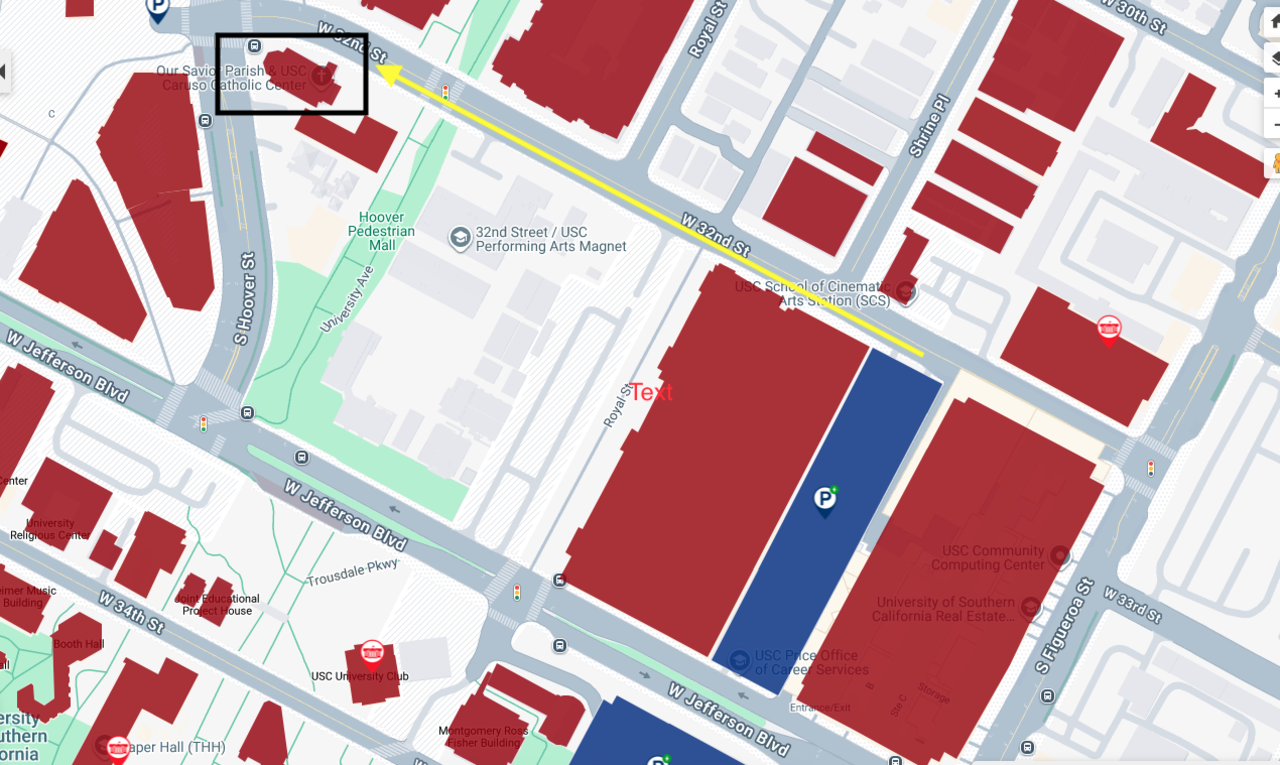
See the map below for reference on where to park on the day of the event. There is parking available at the Shrine parking structure, highlighted in blue. The yellow arrow indicates the route to the Caruso building.
6 Special Thanks
7 Sponsors